Design decisions
How the $1,000 Drop works, and how to make a tee people buy
The $1,000 Drop is our T-shirt design contest. You make a T-shirt design, publish it, enter it on the contest page, and then people either buy it or they don't. The entry bought by the most different people wins $1,000, as long as at least 25 different people bought it. Entries open on November 17, 2026 and close on December 14, 2026. The contest page has the steps and the prizes, and the official rules have the final word on everything. This post covers what you'll want to know while you're making the thing: how buyers get counted, which design to enter, and how to make a tee that someone who has never met you would pay for.
What counts as a buyer?
A buyer is someone who pays for a T-shirt printed with your entry between November 17 and December 14, 2026. There's a second condition: on the count date, December 28, 2026, that order has to have shipped, and it can't have been canceled, refunded or charged back. So the shirt is paid for by December 14 and out the door by December 28.
Each person counts once. Someone who orders four of your tees is one buyer, and if they order again a week later they're still one buyer. Two people at the same shipping address count as one between them. Only T-shirts count, so an order of your entry on any other product adds nothing.
The two weeks between the deadline and the count are there for shipping. Every shirt is printed after it's ordered, and production takes 2 to 5 business days before the carrier has the parcel (how print on demand works follows an order through those steps). An order that's paid in time and then canceled before it ships never becomes a buyer.
The grand prize needs at least 25 buyers. If no entry gets there, the leading entry wins the smaller Leader's Prize instead, and if no eligible entry has a single buyer, neither prize is awarded. The amounts are on the contest page.
We count from our own order records, and we may check orders, accounts, addresses and payment records to confirm the count. Any standings posted before the count date are unofficial. They show your display name, your entry and its count. They never show who bought it: buyers' names and addresses aren't published and aren't given to entrants.
Which orders do not count?
Your own, to start with. The same goes for any order you paid for, paid back or rewarded, in whole or in part. Buying your tee for a friend is an order you paid for, and sending a friend the money afterward is a reimbursement. The table has every case the rules name.
The rules also bar the behavior behind those orders. You must not order your own entry to raise its count or have someone in your household do it, and you must not pay, reimburse, discount or reward anyone for ordering or liking an entry. If we reasonably believe an entrant broke these rules, we may disqualify them, and a disqualified entrant loses any prize.
Likes are counted separately from buyers, and they break ties. If two entries have the same number of buyers, the one that got more likes during the contest period wins, and if they're still tied, the one entered first wins. Likes also decide the Community Favorite prize, which goes to the most-liked entry other than the grand prize entry. Each account can like an entry once.
| The order | Does it count? |
|---|---|
| Someone outside your household orders your tee in the contest period, and the order has shipped by the count date | Yes, as one buyer |
| The same person orders again, or orders several shirts | Still one buyer |
| Two people who share a shipping address each order | One buyer between them |
| Someone orders your entry on a product that is not a T-shirt | No |
| You order your own entry | No |
| A member of your household orders, or the order ships to your address | No |
| You paid for the order, reimbursed it or rewarded it, in whole or in part | No |
| An Inkdrop employee or contractor, or someone in their household, orders | No |
| The order is canceled, refunded or charged back by the count date | No |
| Someone orders a remix or a copy of your entry | No |
From rule 6 of the official rules. Inkdrop also leaves out orders it reasonably believes were placed to manipulate the result.
Which of your designs should you enter?
Enter the one a stranger gets without you standing next to it. You can enter up to 3 designs. Each has to be a T-shirt design made in Inkdrop during the contest period, from a typed idea or from your own artwork or photo, so anything you made before entries opened can't go in.
Making a design uses AI credits. You can claim 60 free credits on the contest page, once, while entries are open. That's enough for 3 one-sided designs at Standard quality. Additional sides, edits, retries, and higher quality use more credits. Buying more credits won't move an entry up.
To choose between candidates, look at each one on the shirt and show the preview to someone who hasn't heard the idea behind it. If they can tell you what it is in a few words, the design explains itself. An inside joke can be exactly the right shirt for you and your friends. In this contest, everyone outside the joke has to want it too.
Counts are kept per entry. A remix of your own design is a separate entry, and orders of a remix never count toward the original, so two versions of one idea each need their own buyers.
Some designs can't be entered at all. An entry has to be your own original work. Artwork made with Inkdrop's tools from your own idea qualifies, and so does uploaded artwork you own. Characters, brand logos, team marks and copied artwork are out. So is a celebrity's likeness, or any other person's without their written permission. A remix of someone else's design can't be entered either. The content policy applies, and we may ask you to show that the work is yours.
Entries and orders stop counting at the same moment, so a design made on the last evening has only hours in which to be bought. An entry also has to stay published: while it's unpublished or removed, it isn't eligible. You can withdraw an entry on the contest page until the count date. Once you do, it's out of the contest and its orders no longer count.
How do you make a T-shirt design that reads on a shirt?
This part is advice, and it's the same advice we'd give for any shirt: one idea, large shapes, strong contrast with the shirt color, recognizable from a few steps away. Buyers decide the winner here, so the design has to work at first glance.
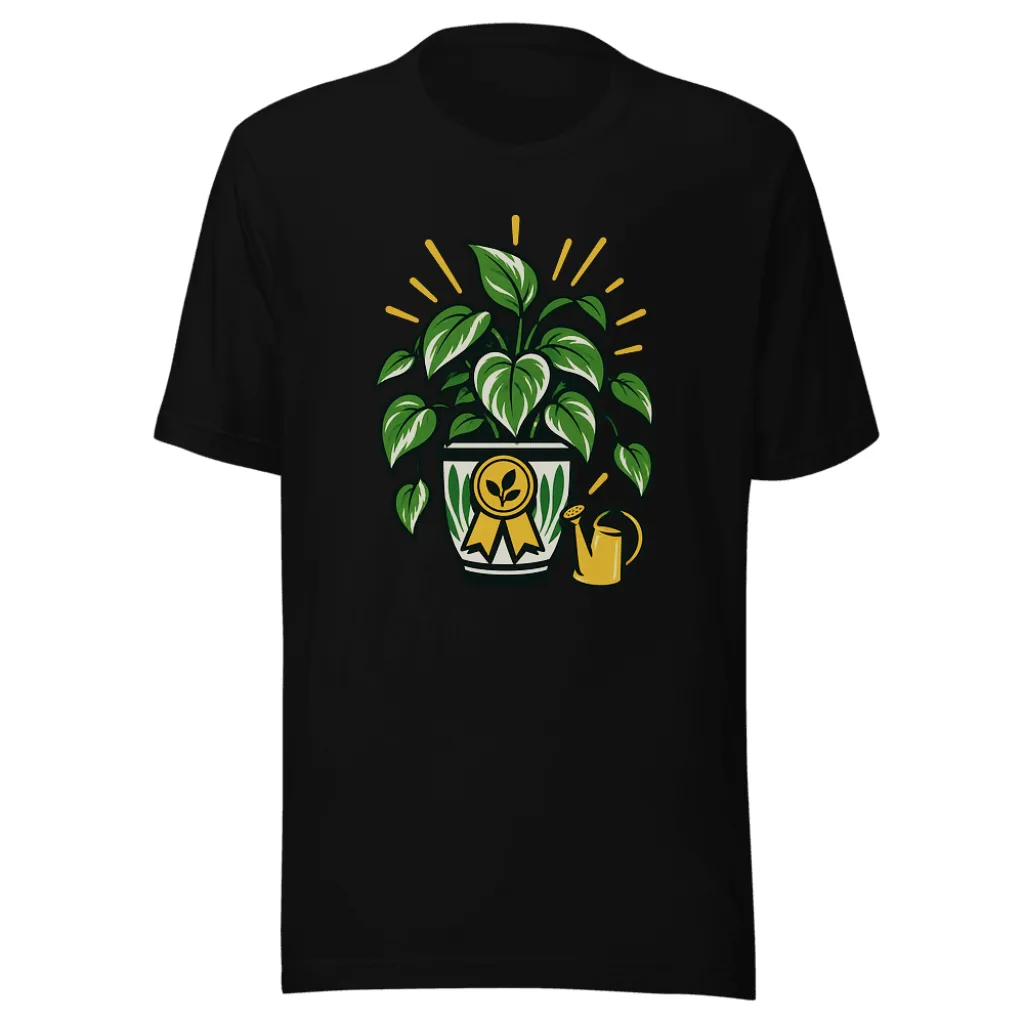
Start with one subject a stranger can name. The tee in the picture began as one typed sentence: I kept my first houseplant alive for a whole year. What came out is a single plant with a prize rosette and a watering can, with no scene behind it.
If you write your own prompt in Create, name one subject and one style. "A heron standing in reeds, bold woodcut style, three colors" gives the model a shape, a technique and a palette. "A beautiful detailed nature scene" gives it permission to fill every pixel. Our AI design walkthrough and the prompt examples take a prompt like the first one from the idea to the shirt.
Keep the shapes large. Fine lines and tiny lettering soften on fabric, so if you have to zoom in to see a detail, cut it. If the design has words, keep them short and big, and read every letter in the preview, because AI models still misspell. The custom text shirt ideas show how short a line has to be to read from across a room.
How do you check a design before you publish it?
Look at it on the shirt, then look at it small. Dark lettering and outlines usually read best on a light tee, and light ones on a dark tee. A dark outline that looks sharp on white can vanish on navy, so switch the shirt color once in the preview before you decide. The color guide has a table of which details stay readable on which shirt.
For the distance test, shrink the product preview until the whole shirt fits on your phone screen and give it a quick glance. If you can still name the subject and read the words without zooming, it passes. If it has turned into texture, enlarge the subject or cut detail and look again. The design size guide has a paper test that answers the same question at real size.
Check the edges too. If a square shows around the artwork and you didn't mean it to, check whether the artwork has a transparent background. The background guide covers that choice.
Keep in mind that a preview is a digital mockup. It shows composition and contrast. It isn't an exact color proof, because fabric, ink and screen differ.
What are the rules for voluntary promotion?
Sharing, reposting, tagging people or otherwise publicizing the contest on Meta products, including Facebook and Instagram, is not required to enter and does not itself earn an entry, prize or scoring credit. Neither Inkdrop nor entrants may require or incentivize those actions as part of the contest.
If you voluntarily promote an entry where permitted, disclose that it is entered in a contest with a cash prize. A product preview is a digital mockup, not a photo of a printed shirt; describe it accurately.
Be straight with buyers about what they're getting. It's an ordinary purchase at Inkdrop's normal price, and orders ship within the United States only. A buyer isn't entered in anything and wins nothing by ordering. You don't earn a commission or royalty on those orders either, since the prizes are the only payments in the contest.
Each shirt is made for its order, so it can't be returned for a change of mind or a sizing mistake. The size guide explains how to choose a size before ordering.
Each qualifying buyer counts once, regardless of the number of shirts, and two people at one address count as one. The order has to be paid before entries close and shipped by the count date. These are order rules, not rewards for social activity.
The rest of the rules cover whatever you post: no payment, reimbursement, discount or reward for an order or a like, one account per person, and no bots, scripts, or fake or purchased accounts. You also have to follow the rules of the site where you're posting.
What are the dates, and what happens after entries close?
The table has the four dates. All times are Eastern Time, and our servers are the official clock.
If your entry has the most buyers on the count date, we email you within 5 business days after that date, at the address on your Inkdrop account. A potential winner must reply within 7 days and, within 14 days, return a signed declaration of eligibility, a liability release, a publicity release where the law allows one, and any tax form. If we can't reach them, or they don't return the documents or aren't eligible, the prize goes to the entry with the next highest count.
Prizes are paid in US dollars by bank transfer within 30 days after the winner is verified. The winner pays all taxes on the prize, and each person can win one prize.
You keep ownership of your entry. By entering you give Inkdrop a non-exclusive, royalty-free, worldwide license, for the contest period and 12 months after it, to host, display, reproduce and print the entry on products ordered through Inkdrop, and to show the entry, your display name and its standing on inkdrop.fun and in our emails, social posts and advertising about the contest.
The contest is open to legal residents of the 50 United States and the District of Columbia who are 18 or older when they enter, or the age of majority where they live if that's higher. It's one Inkdrop account per person, and no purchase is needed to enter. The official rules list who can't enter and everything else this post leaves out. Where this post and the rules differ, the rules win.
| Date | What happens |
|---|---|
| November 17, 2026 | Entries open at 12:00:00 a.m. A design made before then cannot be entered. |
| December 14, 2026 | Entries close at 11:59:59 p.m. An order has to be paid by then to count. |
| December 28, 2026 | The count date. An order has to have shipped by 11:59:59 p.m. to count, and an entry can be withdrawn until then. |
| December 30, 2026 | Inkdrop posts the result on inkdrop.fun on or about this date. |
From rules 3, 4, 6 and 9 of the official rules. All times are Eastern Time.