Design decisions
Custom text shirt ideas that print well
Words are the most-wanted kind of custom shirt, and the easiest to get wrong: a phrase that is too long, type that is too thin, or colors that vanish on the fabric. Keep the phrase short, the strokes thick and the contrast high, and the words will read from across a room. Below are ideas to start from, the lettering styles that suit a shirt, and the few numbers that keep the words readable. In Inkdrop, the Bold Statement concept turns the exact words you type into a lettered design, so the decisions here are the ones you will actually make.
What makes a text shirt work
One idea, few words. Bold Statement caps the main line at 28 characters and an optional second line at 24, and that is not a technical limit so much as a design one: a shirt is read in the second someone glances at it, and a sentence becomes a paragraph at chest size. Printful's typography guide gives the matching rule for type: at most two faces, one for the headline and one quieter one for the supporting line, because three or more compete.
Capitals suit short statements. Butterick's Practical Typography notes that all caps are fine for less than a line, which is exactly a shirt, and that caps need a little extra letterspacing, about 5 to 12 percent, because words set in capitals lose the up-and-down shape that makes lowercase easy to read. Lowercase suits a longer or softer line, a lyric you wrote, a date, a place.
Decide what the second line is for before you add one. A date, a name or a punchline set clearly smaller than the statement works; a second line that repeats the first in different words does not. If you want a small picture, keep it to one motif that stays out of the way of the words, which is how Bold Statement treats it.
Ideas by occasion
For yourself: a personal motto you actually say, a one-word reminder, the name of the thing you do on Saturdays, the year you started something, a phrase from your family that nobody else would understand. The best ones are specific; a shirt that says STAY WILD is a mood, a shirt that says BACK IN FIVE over a tiny lunchbox is a person.
For a group: the trip name and the dates, the inside joke from the first night, the group chat's name, a reunion with the family name and est. and the year it started, the team name on the front and a number on the back. Groups print well in one ink on a matching shirt color, and the hoodie placement guide covers the front-and-back pairing most teams want.
For a gift: the thing the person always says, their title in your house, a running count, a milestone they just hit; our Small Win Badge concept turns a small achievement into an emblem with more ceremony than it deserves. For pet owners, the cat's or dog's name with their best habit beneath it, which pairs naturally with the pet T-shirt designs. Across all of these the pattern is the same: write the line as you would say it out loud, then cut every word that is not pulling weight.
Lettering styles and what they say
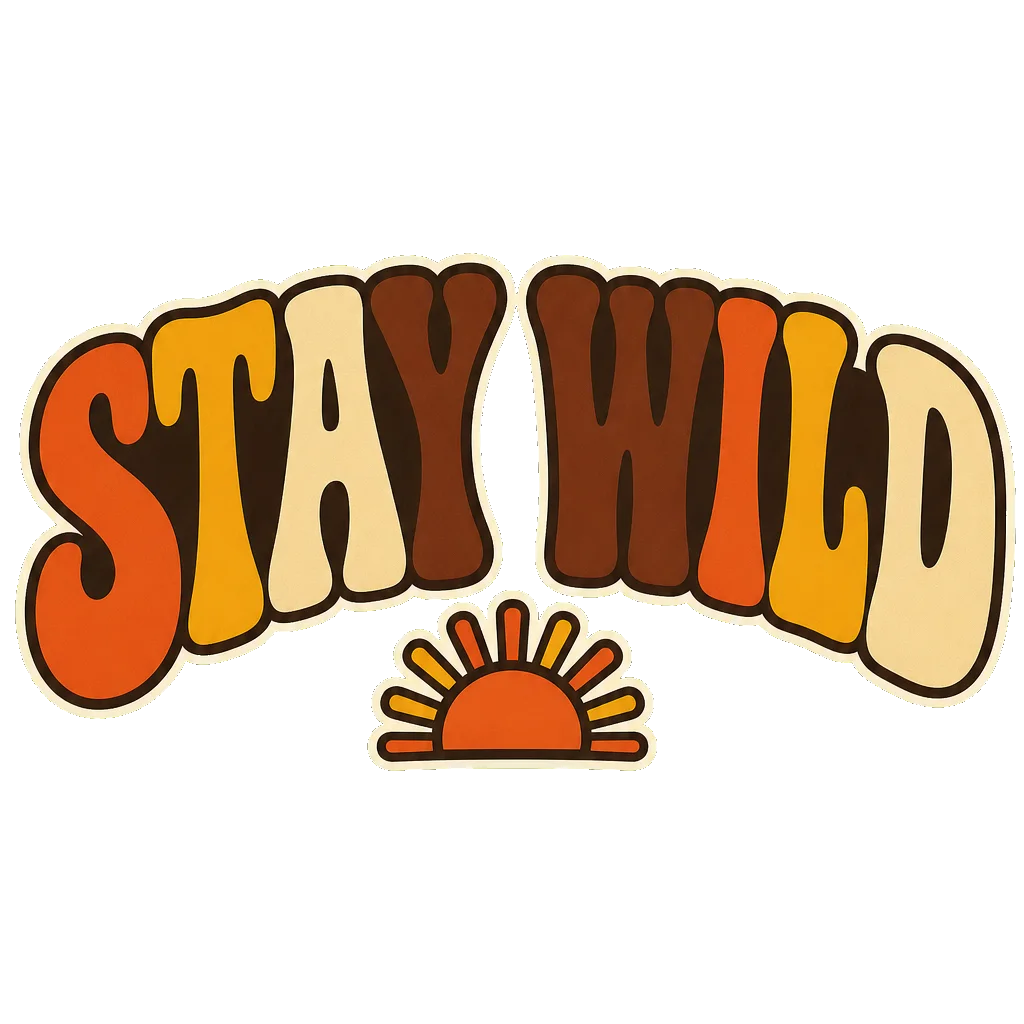
Bold Statement offers five lettering styles. Groovy 70s is rounded and bouncy, the look of a seventies band tee, and pairs with the arched layout and the Sunset or Earthy palette. Varsity block is the squared collegiate letter, best stacked or in a circle around a motif, and the natural choice for team and reunion shirts. Modern heavy is a thick, plain sans serif that reads at any distance and suits a dry one-liner in one ink. Hand brush is loose and painted, for softer or funnier lines. Western serif has the spurs and slabs of a saloon sign and works for place names and anything with a date.
Layouts: Stacked puts the words in lines down the chest; Arched curves the statement over a motif or on its own; Circle sets the words around a small picture like a badge; Ribbon banner runs them along a scroll. Palettes are Sunset, One ink, Neon, Earthy and Pastel. One ink is the safest on every shirt color and the cleanest for a group order; the vintage design guide explains why the seventies styles like a limited palette.
Type the words exactly as you want them printed. Ink works from your text, so check spelling, capitals and punctuation in the preview before you order; the preview is the proof. For period lettering with a palette to match, see the retro T-shirt design hub.
Make the letters print
Size first. Printful's design tips ask for headlines of at least 36 points and secondary text above 18, and Threadless's direct-to-garment guide sets the floor at about a quarter of an inch for text and 2 points for any line on a 300 pixel per inch, 14 by 16 inch template. In practice a one-line statement across a 10 to 12 inch chest print, the typical full-front width in Printful's placement guide, is far above those limits; a long second line in a thin face is where shirts fail.
Stroke weight next. Printful's font guide says to keep strokes above a point so letters do not fade into the texture of the cotton, and to avoid tiny serifs and script faces that blur together on fabric; on dark shirts it suggests going one weight bolder than you would on screen. Bold Statement's styles are all display weights for this reason, and Hand brush, the lightest, is the one to check closely in Design view.
Contrast last, and it is the one people forget. Printful's rule is a clear difference in lightness between ink and fabric, at least 4.5 to 1 in its font guide; navy letters on a black shirt disappear, and white letters cannot be printed on a white shirt at all. Pick the shirt color in Create and look at the words in Product view before you decide. The design size guide has a paper test for width, and the print resolution guide covers the files if you are bringing your own lettering.
Can you print a slogan you did not write?
Short phrases are a special case in copyright. The US Copyright Office's circular on works it does not protect lists names, titles, slogans and other short expressions as too brief to be copyrighted, and says the same of typefaces and lettering. That is why a line of your own invention is yours to print without paperwork, and why nobody owns a phrase like good morning.
Trademark is the other half. The same circular points out that a short phrase can be protected as a trademark, and the USPTO defines a trademark as a word, phrase, design or combination that identifies the source of goods, with slogans and logos included. A brand's tagline, a team name, a show's catchphrase or a company name on a shirt you are selling or giving away can be a problem even though copyright does not apply. Lines from songs, poems and books are different again: a short quote may be fine, but the work it comes from is protected, and we do not take the view that a lyric is fair game.
Our content policy asks you to print words you wrote or have permission to use, and Bold Statement will not add logos or characters to get around that. When in doubt, write your own version; it will be funnier anyway.
Order it
As of November 2026, T-shirts start at $15.03, hoodies at $33.10 and tote bags at $28.06, and the exact price shows in Create before you pay. Standard US shipping starts at $4.95 for a T-shirt. Production takes 2 to 5 business days and shipping adds 3 to 4, so most orders arrive 5 to 9 business days after payment, within the US only. How print on demand works explains the steps between your order and the parcel.
A text shirt is made for your order, so it cannot be returned for a change of mind, a typo you approved in the preview or a sizing mistake; check the words one more time and use the Size guide in Create. If it arrives damaged or misprinted, tell us within 14 days of delivery with photos and we will replace or refund it. More lettering examples are on the graphic tee ideas page.
Sources and further reading
- Printful: 28 best fonts for T-shirts
- Printful: Custom T-shirt design tips
- Printful: T-shirt design placement guide
- Threadless: Designing for DTG printing
- Butterick's Practical Typography: Letterspacing
- Butterick's Practical Typography: All caps
- US Copyright Office: Works not protected by copyright (Circular 33)
- USPTO: Trademark, patent, or copyright