Design decisions
How to design a custom tote bag that prints well
A tote bag is seen in motion, folded over an arm or slung on a shoulder, from across a street. Good tote designs accept that and use one bold motif, thick lines and colors that hold on canvas. Start inside the print area, respect the fabric, pick a palette that holds on natural cotton, and check the ordering details for a bag printed with us.
Start inside the print area
Open Create, choose a tote, and look at the print boundary on the bag before you think about artwork. It covers the central panel of the bag, and everything you want seen has to live inside it, including any words.
Keep the main image away from the edges of that boundary. A bag bends and folds when it is carried, so artwork pushed to the edges disappears into a crease or wraps under the arm. Leave space around the subject; a design that fills the whole panel looks like a sticker on a bag.
Center the subject in the print boundary. A square or roughly vertical motif sits well in a tote panel; a wide, flat design has to shrink to fit and loses impact. If the preview looks cramped, reduce the print size rather than pushing the artwork toward the edges.
Each tote comes in one size, and three are in our catalog: the Eco Tote and the Large Eco Tote by Econscious, and the Cotton Tote by AS Color. You pick the bag and its color in Create, and the preview shows your artwork on that exact bag.
| Tote | Bag size | Fabric |
|---|---|---|
| Eco Tote (Econscious EC8000) | 16 × 14½ × 5 in | 8 oz organic cotton twill |
| Large Eco Tote (Econscious EC8001) | 20 × 14 × 5 in | 8 oz organic cotton twill |
| Cotton Tote (AS Colour 1001) | 16½ × 16½ in | 320 g/m² cotton |
Supplier figures from the catalog's product pages. Create shows the print area for the tote you pick.
Why does canvas soften fine lines and small text?
Tote bags are woven cotton, usually canvas: a heavy plain weave with thicker threads and a more textured surface than a T-shirt's knit. DTG ink lands on that texture. Threadless's DTG design guide calls out textured products such as totes as the place where fine linework blurs and readability drops, and the fix is the same everywhere: thicker lines, bigger lettering, fewer tiny details.
A hairline that looks crisp on your screen becomes a soft gray thread on canvas. Hatching, tiny stars, thin serifs and small words all suffer. If a detail is important, make it larger or drop it. In the preview, open Design view and judge the thinnest line you can see; if you squint and it goes, it will go on the bag.
Lettering follows the same rule. A short phrase in a heavy typeface prints cleanly; a sentence in a thin script turns into a smudge from a few steps away. If the words matter, give them the same weight as the picture, or make them the picture.
Hand-drawn and typographic designs do well here because their lines are already heavy. The minimal line and bold statement concepts in Create are built around that kind of weight, which is why we suggest them on the tote page.
Colors that hold on natural cotton
Natural cotton is cream colored. Pale yellows, light pinks and pastels lose contrast against it, and anything that depends on bright white space will look different than it does on a white screen. Dark inks and saturated mid-tones read well: deep green, brick red, navy, black, a strong orange.
Two colors are plenty for most totes: one dark for the drawing and one accent for a fill or a word. Choose the accent for contrast with cream, such as teal, coral or mustard, and keep both colors flat. Pale tints are where cream canvas disappoints.
Check the palette against the bag color in Product view. If you choose a colored tote rather than natural, check again, because the fabric becomes part of the design. Printed color also differs from screen color, and a DTG printer mixes from a fixed set of inks, so treat the preview as a composition check and not as a color proof.
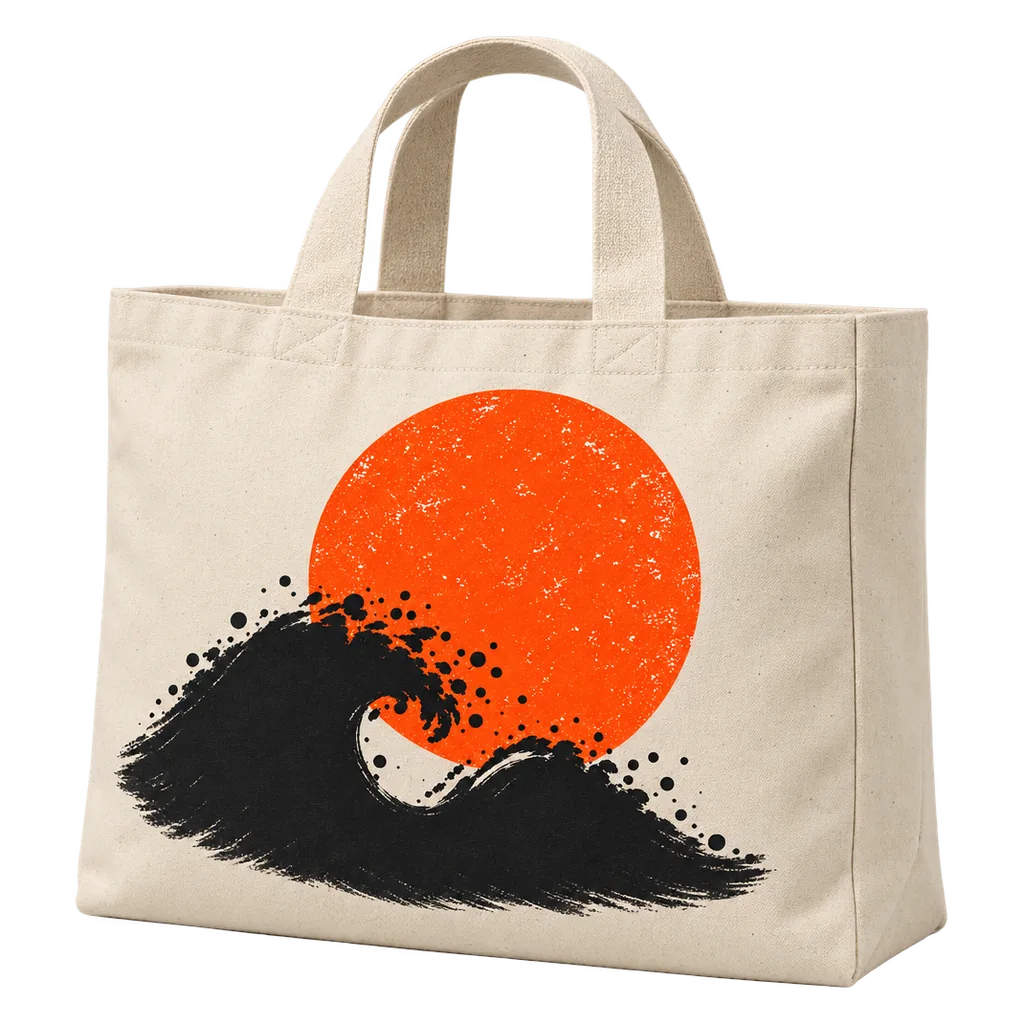
One ink works on a tote. A single dark color, drawn with weight, reads from farther away than a full-color illustration and ages well as the bag softens with washing.
One bold motif beats busy art
People recognize a tote while it is being carried, so the design has about a second to land. One subject, a few words or a single shape does that; a busy scene does not. Printful's round-up of tote design ideas leans the same way, toward minimalism and bold typography. Our 24 tote bag design ideas are grouped the same way.
Pick the focal point first, then decide whether it needs words. If it does, keep them short and large. Then step back: Product view at normal size, on your phone if one is nearby, is the test. If you cannot name what the bag is about in a glance, simplify.
Words alone work too. A short phrase set large, in one or two colors, reads while the bag moves, which is why so many totes carry one. The bold statement concept in Create is built for this, and the one-word creature concept turns a single word you choose into an animal drawn in a surprise style, which gives a bag a subject without a crowded scene.
A mascot, a plant, a lettered phrase, a creature drawn from one word: these work because each is one thing. Our tote bag ideas page collects public previews so you can compare approaches before you make your own.
Totes as gifts and for events
A tote is an easy gift because there is no size to get wrong. A market bag with a friend's favorite vegetable on it, a book bag with their own words, a welcome bag for a weekend away with the name of the house: one design, one bag.
For an event, order one first and look at it in your hands before you order several. Every bag is printed to order and there is no minimum. Leave time: production takes 2 to 5 business days and standard US shipping adds 3 to 4, so most orders arrive 5 to 9 business days after payment.
A worked example: a book club wants a bag for each member for the fall season. One member picks a line drawing of a stack of books with the club's name beneath, in one dark ink, on the natural Eco Tote. She orders one, checks the lettering and the ink against the cream, then orders the rest with three weeks to spare. Everyone gets the same bag, and nobody had to pick a size.
Care is simple: wash cold and air dry. Tell the recipient, because a hot dryer is hard on any printed cotton.
Order the tote
As of November 2026, totes start at $28.06 and the exact price shows in Create before you order. Standard US shipping starts at $4.69 for a tote, and we ship within the US only, to the address you enter at checkout.
Because the bag is printed for your order, we cannot accept returns for a change of mind. You can cancel until the order enters fulfillment. If a tote arrives damaged or misprinted, contact us within 14 days of delivery with photos of the bag and the packaging, and we will replace it at no cost or refund it in full.
The same artwork can go on a T-shirt or a hoodie; pick a different product when you customize the design and the preview updates. T-shirts start at $15.03 and hoodies at $33.10 as of November 2026.
Use artwork you made, generated or have permission to use. A logo, a character or a photo found online is not cleared because it is on a bag.