AI design
How to make a custom cat shirt from a photo or a habit
Cat shirts come in two kinds: the portrait, where it has to look like your cat, and the joke, where it has to look like something your cat would do. Inkdrop has a concept for each. Funny Cat Moment turns one habit into a shirt-sized cartoon, with an optional photo so the cat stays recognizable, and Pet portrait works from a photo alone. This guide covers the photo, the habit, the styles, the shirt color and the whiskers.
Take a photo the AI can read
Cats do not pose, so you work around them. Cats Protection's photography guide suggests shooting just after your cat has eaten or woken up, when it is relaxed, and having someone dangle a toy just out of frame to get the ears up and the eyes on you. Use natural light, outdoors in shade or next to a window, with the flash off; a flash startles the cat and flattens the fur. Nikon's guide adds a trick for a clean background: hang a plain sheet or blanket behind the spot your cat likes, and put the camera on the floor, tilted up, for a view at its level.
Focus on the eyes. Both guides make it the one rule; on a phone, tap the eyes on screen before you shoot. Use burst mode and keep the frame where the eyes are sharp, even if the cat is looking slightly away. Avoid the digital zoom, which throws away pixels; move closer or crop afterwards. Black cats are the hard case, and Nikon's advice is to separate them from the background with light from the side rather than photographing them against something dark.
Fill the frame with the cat and keep the background plain, because the background is what the AI has to remove. If your cat has a marking that makes it yours, a white chin, a crooked tail, one folded ear, make sure it is in the photo and type it into the markings field as well, so Ink knows what to protect.
Turn a habit into the joke
Funny Cat Moment starts with the habit, not the face. You describe what the cat should be doing in up to 100 characters, and the best material is the behavior every cat owner recognizes. The cat charities have catalogued most of it. Cats Protection's behaviorist explains that knocking things off tables is curiosity, a cat investigating an unfamiliar object with its paws; that cats climb onto counters and curtain rails to get high and feel safe; and that the early-morning wake-up call is because cats are most active at dawn and dusk.
International Cat Care adds the rest of the repertoire: kneading, a kitten behavior adults keep for comfort; chattering at birds through the window, which may be frustration, anticipation or mimicry; the mad moments of racing round the house at dusk; and the head-bunting that marks you as part of the cat's group. Cats Protection's note on boxes is that a box is a private, secure place with insulating walls, which is why the expensive bed sits empty next to the Amazon packaging.
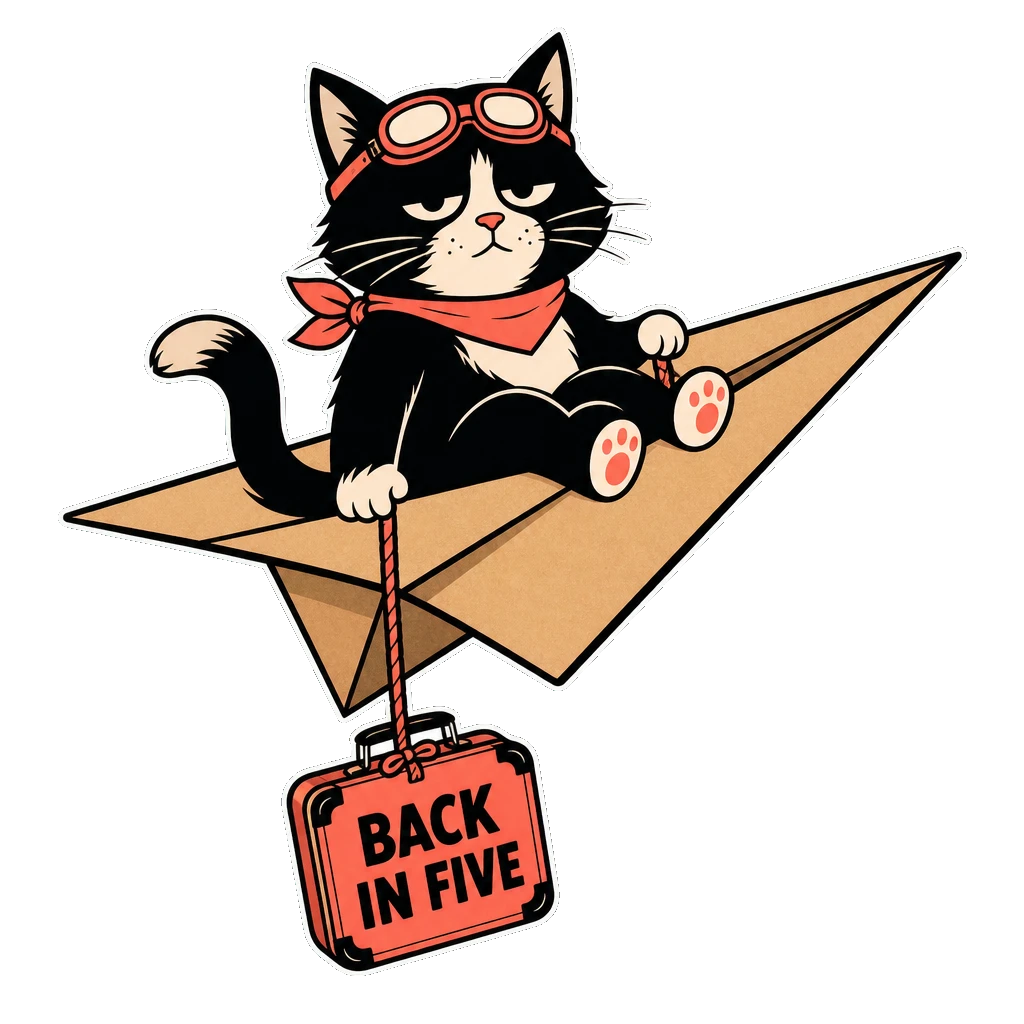
Any of those is a shirt. Write it as a scene, guarding snacks, peeking from a pocket, riding a paper airplane with a lunchbox, and choose the cat's energy, Curious, Unbothered, Cozy or Chaotic, and a color mood, Ink & cream, Coral & ink, Peach trio or Full color. You can have one, two or three cats, with one clear photo per cat if you want them recognizable, and a caption such as BACK IN FIVE. Ink turns the habit into one clean visual joke made to read instantly on a tee.
Portrait styles that suit cats
If you want a portrait rather than a joke, the styles are the ones pet-portrait studios name. The Family Portrait Company's rundown covers minimalist line art, a few confident lines that catch the shape of the ears and the set of the eyes; watercolour, soft and fluid, which suits a tabby's markings; pop art in the Warhol multi-panel manner, which turns one photo into four colored versions; cartoon, for a cat with a memorable pose; and the royal portrait, a tabby painted as a seventeenth-century monarch.
On a shirt, each style has a condition. Line art prints in one ink on any shirt color and is the most forgiving of a mediocre photo, but every line has to be thick enough to survive fabric. Watercolour needs a light shirt, because direct-to-garment ink on white needs no underbase and keeps the washes soft, while on a dark shirt the white underbase shows through pale areas. Pop art and cartoon styles with bold outlines and flat color are the easiest of all to print and read from across a room. Our Pet portrait concept covers these with portrait personalities, frame motifs and palettes, and takes up to two photos; the dog shirt guide walks through it, and everything there applies to a cat.
Which shirt color for a black or white cat?
Color is where cat shirts go wrong, and it is a printing fact rather than a design one. Threadless's direct-to-garment guide explains that black in a design is printed as ink on every garment, including black shirts, so a black cat on a black shirt comes out as a slightly gray cat with fuzzy edges rather than vanishing into the fabric. The fix is contrast or transparency: put a black cat on a cream, sand or light gray shirt, or draw it so the shirt itself is the black and only the eyes, whiskers and outline are printed.
White cats have the opposite problem. White ink is not printed on white shirts, so a white cat needs a colored shirt, and on a dark shirt it is printed over a white underbase, which Printful's color guide describes as the step that keeps light colors bright on dark garments. Printful's rule for every pairing is contrast: a design close to the shirt color disappears, and it gives navy on black as the example. A tabby or a ginger has the easiest time; choose the shirt for contrast with the darkest and lightest parts of the fur.
Look at the whole shirt in Product view, not just the artwork. A portrait that looks right on a white screen can sit badly on the color you picked, and the preview is where you find out.
Whiskers and fine lines
Whiskers are the thinnest thing on a cat and the first thing to go on fabric. Threadless's guide sets the floor for direct-to-garment at lines no thinner than 2 points and text no smaller than about 18 points on its 300 pixel per inch template, and notes that the white underbase can sit slightly off thin lines on colored shirts, which shows as a faint ghost. A bold outline around the whole cat, the sticker look, hides a rough cutout edge and keeps the silhouette strong even when individual whiskers soften.
In Create, switch to Design view and zoom into the whiskers, the ear tips and the edge of the fur; anything that looks delicate on screen will look broken on the shirt. A transparent background is the right setting for a portrait that floats on the fabric, and fur against a busy background is the hardest cutout there is, which is why the plain sheet in the photo matters. The design size guide has the rule for how wide a chest print should be; a face needs the center of the chest, not the pocket spot.
Order it, or give it
As of November 2026, T-shirts start at $15.03 and the exact price shows in Create before you pay, with standard US shipping from $4.95. Production takes 2 to 5 business days and shipping adds 3 to 4, so most orders arrive 5 to 9 business days after payment, within the US only, to the address you enter, which can be the recipient's. For a gift, ask for the person's size; the shirt is made to order and cannot be returned for fit or a change of mind, as our returns policy explains.
If it arrives damaged or misprinted, tell us within 14 days of delivery with photos and we will replace or refund it. Use your own photos, and expect the same portrait to work on a hoodie or a tote; the pet T-shirt designs page has examples people have made, and how print on demand works explains what happens after you order.
Sources and further reading
- Cats Protection: How to take amazing photos of your cat
- Nikon: Cat photography, capturing cats in pictures
- Cats Protection: Why is my cat being naughty?
- Cats Protection: Why do cats love boxes?
- International Cat Care: Why do cats...?
- Threadless: Designing for DTG printing
- Printful: T-shirt and ink color combinations
- The Family Portrait Company: Top pet portrait styles